

Editor’s Note: This interview first appeared in Path Finders, an email newsletter from the Daily Yonder. Each week, Path Finders features a Q&A with a rural thinker, creator, or doer. Like what you see here? You can join the mailing list at the bottom of this article and receive more conversations like this in your inbox each week.
Every year the U.S. Census Bureau publishes the American Community Survey (ACS), a detailed dataset that captures information on American social, economic, housing, and demographic trends. The ACS serves as an annual supplement to what the Census provides, which is only collected once every 10 years.
The Daily Yonder uses ACS data to cover topics such as SNAP participation, poverty rates, and housing availability, among other things. But news organizations aren’t the only entities that benefit from readily accessible and up-to-date information on American life. The ACS is also used by businesses, community planners, government agencies, and researchers for a range of decision-making and research purposes.
Unlike the decennial Census, the ACS takes a statistically representative sample of a population, using estimates instead of full counts in their figures. Although not every household receives an ACS survey in the mail every year, the ones that do are required to fill out the form and send it back to the Census Bureau.
But some Republican legislators have proposed making the ACS a voluntary survey, citing concerns about privacy and government overreach. Data experts say that a voluntary survey will disproportionately hurt rural communities and marginalized groups by reducing the quality of the data available for and about those communities.
I sat down with self-proclaimed data nerds Joan Naymark and Kelly Asche to talk about their concerns regarding the proposal of a voluntary ACS, and why data is important for rural communities.
Naymark is the founder of Minnesotans for the American Community Survey (MACS), an organization dedicated to promoting and improving the ACS. Kelly Asche is a senior researcher at the Center for Rural Policy and Development.
From one data nerd to another, I hope you enjoy our conversation.
This conversation has been edited for length and clarity.
The Daily Yonder: Why is data important?
Joan Naymark: Only the federal government can provide this information. And no private sector organization has the resources or the desire to do this decade after decade. The [ACS] data are consistent over time, consistent across communities, and they support every aspect of civic and economic life.
Kelly Asche: When you look at the way the government gives out grants and looks at eligibility rules, it’s completely data based, right? A lot of rural communities that are applying for block grants [example: Community Services Block Grants] or are trying to make arguments about food banks and things like that, they can easily pull up data and be like, “this is the percentage of the population that’s on Medicare or Medicaid. This is the percentage of our population that’s low income.”
DY: Why are we talking about data quality right now?
JN: There are a number of things proposed [in Congress] that would make the ACS less accurate, less available, and less useful. Making the ACS a voluntary survey is the key component of this legislation. There is a writer of an appropriation bill, which of course is making the headlines everywhere that we look right now. And then there are two stand alone bills, one in the House and one in the Senate, that were introduced earlier this year. They would do severe damage to the ACS – lower quality, less data, lower response rates. Lower response rates is a nonpartisan challenge. It’s just an issue for everyone.
DY: What are the downsides to the ACS becoming voluntary?
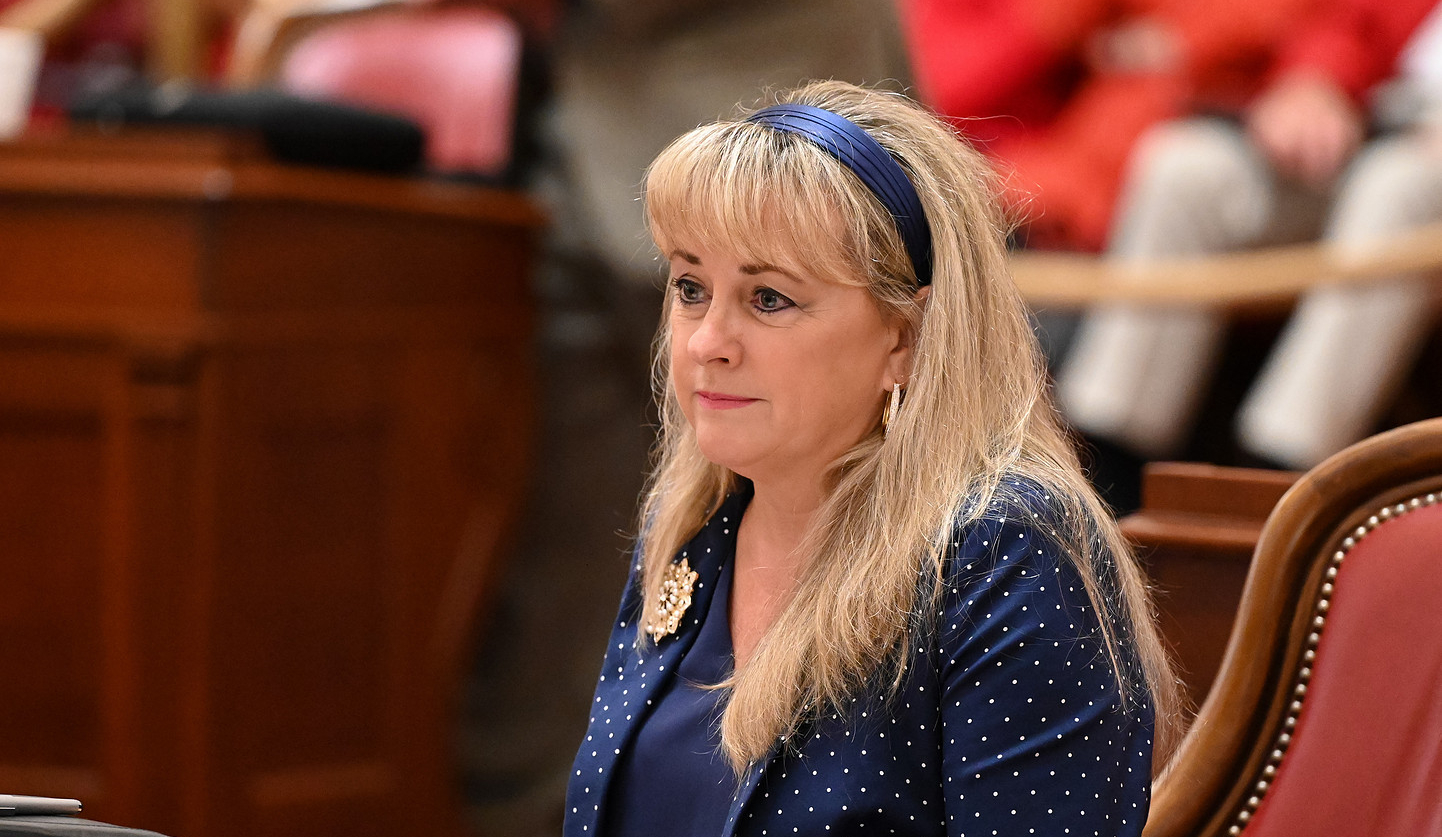
Joan Naymark is the founder of Minnesotans for the American Community Survey (MACS), an organization focusing on preserving the American Community Survey. (Photo courtesy of Joan Naymark)
JN: Canada went to a voluntary National Household Survey, which is their equivalent to the ACS, in 2011. They went from mandatory to voluntary. They just did it kind of out of the blue. And the response rates nationally dropped from 94% to 69%, with a much higher drop off level in rural provinces and small communities. So that really caught our attention. Rural areas were in a really difficult situation. Places north of Minnesota had far less information published, or if it was, it was really low quality.
The Canadian experiment, you know, that was horrendous. They reinstated [the mandatory survey] in the next census five years later.
Kelly, do you want to talk a little bit about on the ground kind of stuff?
KA: I’ll introduce a couple different ideas because there’s the aspect of the data user and then there’s the aspect of the people being impacted by something like this.
Our organization … we were like, “Oh my gosh, pretty much exactly what we’re thinking of doing here, they’ve tried.” We were talking to our Canadian counterpart about all of this. I was like, “What does that look like in Minnesota? If we were to implement this, what kind of data would be available to me?” She straight up said, you know, between 30 and 40% of rural Minnesota probably wouldn’t have data. Just a total blackout.
I’ll give one example. Back in 2015, my colleague blew open the door on childcare shortages in rural Minnesota. They wanted to see the numbers. We were able to look up how many childcare slots are available in rural Minnesota. And then we were able to pull out data from the ACS – the number of children under the age of five with both spouses working. That’s a pretty granular subset. I guarantee you that [under the proposed legislation], we would not be able to have that specific subset available because of the response rate.
County commissioners, cities, and even our philanthropy organizations in Minnesota have taken on childcare. And they’re now able to figure out how much funding we need to dedicate to increasing the number of slots by [a certain number], because we know this is probably the estimate of how much more childcare we need. Without that data, they can’t do any of that.
DY: Did the Canada example hit on what kinds of monetary costs would be involved with voluntary surveys?
KA: I think it was another $30 million in Canada they had to spend to get worse data.
DY: What about the response rates of rural people? How do response rates vary across demographics or geographies?
JN: Census Bureau’s actual threshold is 80% in order to consider the data to be quality. Renters, low income people, people of color, immigrants, young children, people who use social and economic programs … there are a lot of groups who are impacted very negatively by this.
Response rates to the ACS have dropped 10 percentage points. It used to be 98% and now they’re about 85%.
DY: And what do you attribute that to?
JN: Response rates to surveys everywhere are falling off. It really fell after Covid. I think there’s a lot of reluctance to participate in surveys and privacy concerns and so forth. We at MACS are really concerned about the dropping response rate.
Kelly Asche is a senior researcher at the Center for Rural Policy and Development. He lives in rural Minnesota. (Photo courtesy of Kelly Asche)
The ACS has not had an increase in funding for over a decade. It’s just really kind of scary. It’s the only source of information for small areas and yet it’s not getting the adequate financial support.
KA: Luckily here in Minnesota … we have MACS here and a lot of civic background in Minnesota where taking surveys is considered a normal part of life a little bit more. A lot of other states, and I’d say even nationally, we just don’t have champions anymore that take on the civic duty around taking these surveys.
DY: Is there anything readers can do to stop this legislation to make the ACS voluntary?
JN: I think being informed is always helpful as a member of a community, always kind of understanding what the implications are. I think there will be other threats like this. But if people really understand how much of their community is based on accurate and consistent data, then they’ll pay more attention.
KA: I would just encourage people to have conversations about the importance of data. I know it sounds ridiculous, but if somebody gets the ACS, encourage them to take it. Have a conversation around how it’s used.
Part of the issue is that if you don’t understand something, you kind of fill in the gap of knowledge with the worst case scenario or maybe a conspiracy theory. But if you know what it’s used for, these are great tools to help everybody.
This interview first appeared in Path Finders, a weekly email newsletter from the Daily Yonder. Each Monday, Path Finders features a Q&A with a rural thinker, creator, or doer. Join the mailing list today, to have these illuminating conversations delivered straight to your inbox.
Subscribe
The post Q&A: Communities Without Vital Data appeared first on The Daily Yonder.