

When central Illinois farmer Steve Hess found out that his community had won a fight against Navigator CO2 Ventures, a Dallas, Texas-based company building a pipeline to transport carbon dioxide across the region for storage underground, he threw a party.
“It was exhilarating,” he said, about the 2023 win against the Black Rock-backed pipeline where local opposition “knocked down Goliath.”
At the time, Navigator was calling for eminent domain, the right of a company to purchase private land for public good, to route the Heartland Greenway pipeline through farmland across the region. The pipeline would carry liquified carbon dioxide (CO2) across the Midwest to be sequestered underground in rural Christian County, Illinois in a Class VI well. Hess, along with other local residents and landowners, was adamantly against it. They worried about the risks if the pipeline broke.
Before the project was stopped, the Heartland Greenway pipeline was intended to transport CO2 from ethanol plants across five states for sequestration in central Illinois. There are 114 ethanol plants in those five states – South Dakota, Nebraska, Minnesota, Iowa, and Illinois – according to the U.S. Energy Information Administration.
Now, the Illinois legislature is considering a bill that would ban companies from using eminent domain to seize land for CO2 pipelines. The bill was brought to the state legislature by Hess, Sangamon County resident Kathleen Campbell, and other members of the Coalition to Stop CO2 Pipelines, the group that formed in 2022 to fight Navigator and other CO2 pipelines in Illinois.
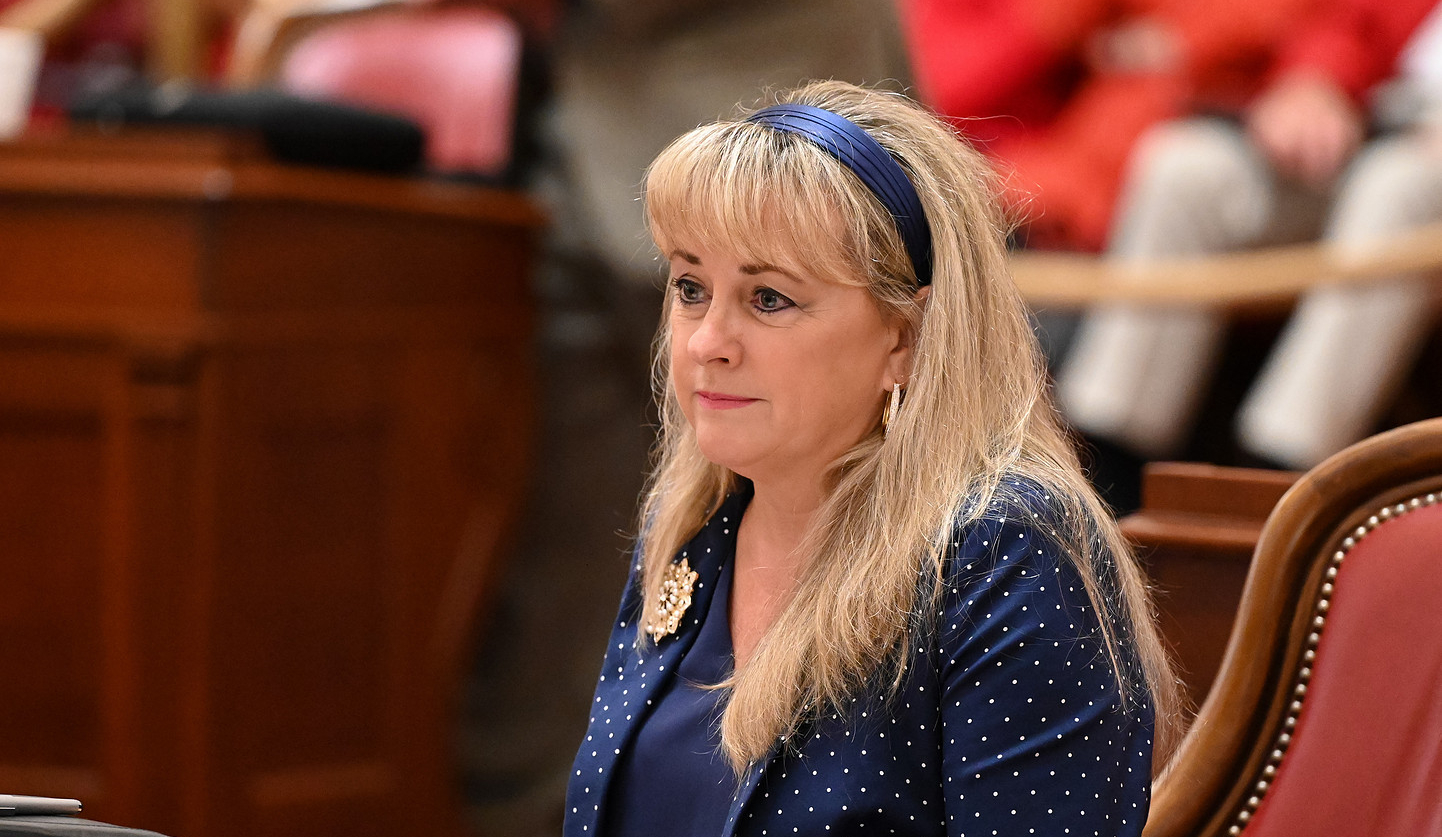
From left to right: Karen Sanders, Kathleen Campbell and Karen Brockelsby are all members of the Coalition to Stop CO2Pipelines. They have all been contacted by developers about having land they own used for pipelines or Class VI wells. (Photo by Ilana Newman/Daily Yonder)
What is Carbon Capture and Storage (CCS)?
A form of carbon removal, Class VI wells are used to store carbon deep under the earth for long periods of time as a way to mitigate CO2, a planet-warming gas, from entering the atmosphere. Central Illinois is home to the Mt. Simon Sandstone formation, a geological feature that’s particularly attractive for the technology, said Anna Littlefield, the manager of the Low Carbon Technologies Program at the Payne Institute at Colorado School of Mines. Developers working on CCS projects look for porous sandstone or limestone with impermeable caprock on top, she said. Central Illinois is a textbook example of this geology.
Susan Hovorka, a research scientist at the Bureau of Economic Geology at the University of Texas, compared the ideal conditions for carbon storage to pouring water into sand – the liquid soaks in – as opposed to concrete, where it puddles on top.
Hovorka said carbon storage is all about the “physics of very small spaces,” likening the size of the holes in the rocks to the space between threads in fabric. When water is spilled on fabric it gets trapped in those small holes, unable to escape except through chemical means, such as drying through exposure to air or heat. That’s what happens when CO2 is pumped underground, where it is insulated from air and heat. Like oil and gas deposits, CO2 injected deep into the earth should – if done properly – remain there indefinitely, Hovorka said. In 2023 and 2024, corrosion in a Class VI well caused carbon to migrate at a facility operated by Archer Daniels Midland in Decatur, Illinois, prompting significant community concern and fueling opposition groups like the Coalition to Stop CO2 Pipelines.
There have been tax credits in place since 2008 to incentivize industrial CO2 emitters to capture and store carbon dioxide. This credit, called the 45Q tax credit, has increased throughout the years and, since the passage of the One Big Beautiful Bill Act in July 2025, now sits at $85 per ton of carbon captured and stored. Hovorka said that the tax credits shouldn’t be the same for carbon sequestration from every industry, because, depending on the complexity of capturing the carbon dioxide, it’s more or less expensive. “I have some stress about the flat tax credit, because the capture cost really varies,” said Hovorka.
Ethanol is particularly cost efficient, she said, which means ethanol plants can “make a mint out of it.” But higher carbon industries like steel and cement plants need higher tax incentives than what currently exist to make the cost of carbon capture worthwhile.
But some CCS opponents, including the Coalition to Stop CO2 Pipelines, worry that there isn’t enough oversight for the 45Q tax credits. “You can make a lot of money doing [CCS] thanks to our tax credits,” said Pam Richart, one of the coalition’s organizers. “The worst part about those tax credits is that there’s really very little accountability. The transparency is not there.”
Putting Pipelines Through Corn Country
Steve Hess farms corn and soybeans near Bushnell, Illinois. (Photo courtesy of Steve Hess)
Hess is a fifth generation farmer (“raising the sixth and seventh generations,” he said) growing corn and soybeans in rural McDonough County, Illinois. The land he farms was homesteaded by his wife’s family in 1869. “Roots run deep here,” Hess said.
He first heard about the Heartland Greenway pipeline in December 2021, when he received a letter in the mail from Navigator. The following year, land agents came out to his property to look at the land they wanted for an easement in order to build the 1,300 mile pipeline.
They were standing in the barnyard when Hess asked the agent what he could do to negotiate with Navigator. “He says, ‘if we get approval and you don’t like it, we can just use eminent domain and put the pipe in anyhow.’ And that really struck me the wrong way,” Hess said.
When exercising the right of eminent domain, an entity can purchase private land, without the permission of the landowner, for the public good. While it’s often used to build public infrastructure like roads, sewage, and water and electrical lines, there’s a long history of using eminent domain to discriminate against Black communities. Between the 1940s and 1970s, the Institute of Justice found that more than 2,500 eminent domain projects displaced one million people, two-thirds of them Black, making them five times more likely to be displaced than they should have been given their share of the population. Eminent domain has also been used by oil and gas companies to build pipelines.
The letters that Hess, Campbell, and other residents received in December 2021 threatened to use eminent domain if the landowners were not amenable to selling their land for the Heartland Greenway Pipeline. (Photos courtesy of Kathleen Campbell)The letters that Hess, Campbell, and other residents received in December 2021 threatened to use eminent domain if the landowners were not amenable to selling their land for the Heartland Greenway Pipeline. (Photos courtesy of Kathleen Campbell)
In Illinois, the Midwest’s many miles of cornfields produce large amounts of corn ethanol, making the region a destination for carbon capture and sequestration.. Ethanol is one of the easiest industries to de-carbonize, Hovorka said, because the emissions from ethanol production contain only CO2 and water. That means storing the carbon only involves dehydrating the emissions before transporting or sequestering them underground. If there aren’t sequestration opportunities on site, for either geologic or economic reasons, then a pipeline needs to be built to transport the CO2 from the capture site to the storage location.
Central Illinois is full of corn and soybean fields. During the spring, high winds can cause dust storms as farmers plow their fields. (Photo by Ilana Newman/Daily Yonder)
“One reason Illinois is a hot spot [for CCS] is because of the proximity to all the ethanol plants,” Littlefield said.
Some states have additional regulations around eminent domain. After opposition to the Heartland Greenway pipeline in Iowa, the state passed a bill in January banning the use of eminent domain for CO2 pipelines.
For Hess, it wasn’t the pipeline that was the issue. He already has a natural gas pipeline on his property, one that was built 55 years ago. “We gave them easement for free, but that was going to help my neighbors,” he said about the pipeline that brought natural gas to the nearby town of Bushnell, Illinois for the first time. But Hess said he can still see the impacts of that pipeline, which runs diagonally through one of his fields. “There’s compaction,” he said, “that leads to weed issues later on in the crop season.” Often, Hess said, these pipelines cut through a farm’s pattern tile – a network of plastic pipes that helps dry out the soil – and the companies aren’t the best at fixing damages.
Archer-Daniels Midland is one of the largest ethanol producers in the United States. This plant, located in Decatur, Illinois, is also the location of several Class VI wells for carbon sequestration. (Photo by Ilana Newman/Daily Yonder)
CO2 Under Pressure
If a CO2 pipeline breaks, it can be dangerous, according to Hovorka. “Anything at pressure is dangerous,” she said, and transporting carbon long distances involves piping CO2 at extremely high pressures in a liquid form.
Such transport comes with risks. A tiny crack or hole in the miles of pipeline can turn into a running ductile fracture, “unzipping” the pipeline across a large distance. To mitigate this, Hovorka said that pipeline manufacturers put crack arrestors at set distances throughout the pipelines to stop fractures from spreading.
When released from a pipeline at a high concentration, CO2 looks and acts like dry ice – a cloud of fog that stays close to the ground. But Hovorka said that it’s not very fast and it’s easy to move away from. The risk comes for those in low lying areas who are unaware of the incoming cloud: a sleeping person or animal unaware of the danger could asphyxiate on the CO2, Hovorka said.
“This is not a completely unknown substance,” Hovorka said. “Our bodies are completely comfortable with CO2,” she added, noting that humans have been using CO2 industrially for decades in the oil and gas industry. The danger, she said, comes from the concentration of CO2 in the air.
In central Illinois, fears of a pipeline leak are not unfounded. Many landowners we spoke with for this story mentioned a 2020 incident in Satartia, Mississippi, a small town along the Yazoo River, where 45 people were hospitalized after a CO2 pipeline ruptured. There, residents described a disorienting, dense fog that caused nausea and dizziness, and stopped cars in their tracks – car engines sputter when they encounter carbon dioxide instead of oxygen. At the time, the community wasn’t prepared for the unique risks posed by leaked CO2.
When asked about the safety risks of CO2 pipelines, Hovorka echoed a Pipeline and Hazardous Safety Administration (PHMSA) report about the Satartia incident. The issue in Satartia was tied to the area’s geography – the pipeline ran down a steep embankment and was affected by a landslide, according to the report. “They screwed up the engineering. They should have dug it in deeper,” Hovorka said.
Educating communities about how to respond to CO2 emergencies is something that Littlefield is passionate about. She wants to make sure that carbon infrastructure development doesn’t come at the cost of the people. “Communities have a lot of power here,” she said, “There’s always a risk when it’s a man-made industrial operation, but these companies are really trying to mitigate those risks as much as possible.”
Grassroots Pipeline Policy Changes
Kathleen Campbell remembers when she got her own letter from Navigator in the mail. It was December 2021, right before Christmas, when she and her husband opened the mailer, which detailed the pipeline plans and sought an easement across their one acre of property outside of Springfield, Illinois. The letter informed Campbell and her husband that if they were unable to come to a voluntary agreement with Navigator, the company could request eminent domain from the Illinois Commerce Commission.
Soon after this, Campbell, Hess, and other local landowners formed the Coalition to Stop CO2 Pipelines, which eventually succeeded in stopping Navigator in 2023 and later, the proposed Iowa-Illinois Wolf pipeline in 2024.
The Coalition helped with the Safe CCS Act, a piece of state legislation to regulate carbon capture, before its passage in 2024. But during the negotiations, the final bill lost all mention of eminent domain. Hess and Campbell knew that they needed to continue the pressure to take eminent domain for CO2 pipelines off the table.
“This is what we’ve been doing the last three years, is building up support,” Hess said. First, Hess got policy passed in the Illinois Farm Bureau to adopt an official stance against eminent domain for CO2 pipelines. Then, in 2025, he went to his legislator, Democratic state senator Michael Halpin, and asked if he would help with eminent domain legislation. Halpin went on to introduce SB2842 in this year’s legislative session, the bill that, if passed, would ban CO2 pipelines from using eminent domain.
Republican State Senator Steve McClure is one of the co-sponsors of SB 2842, the bill that would ban eminent domain being used for CO2pipelines. (Photo by Ilana Newman/Daily Yonder)
Campbell reached out to her own representative, Republican state senator Steve McClure, to get him on the case, too. He agreed to co-sponsor SB2842. “Landowner rights and public safety should override monetary profit,” McClure said. “I’m going to always err on the side of landowner rights and public safety.”
McClure said there’s a chance that the bill will be rolled into an omnibus package before the state legislative session ends on May 31, 2026. If that doesn’t happen, McClure said, the bill could get taken up again in the fall. The bill is a bipartisan effort with 22 cosponsors and endorsements from across industries. “We’ve got the Sierra Club, Illinois Environmental Council, Farm Bureau, and the Soybean [Association]. How many bills do you know that have that combination?” Campbell said.
The post Proposed Bill Would Stop Eminent Domain for Carbon Dioxide Pipelines in Illinois appeared first on The Daily Yonder.