

Arizona is the nation’s sixth-largest state but only the fourteenth most populous. Phoenix and Tucson together account for more than a quarter of its 7.7 million residents. The Arizona Center for Rural Health classifies seven of the state’s 15 counties as 100% rural.
Unless you hunt deer on the Kaibab Plateau or have a taste for whitewater rafting, rural Arizona probably isn’t one’s intuitive first choice for a fresh start.
This out-of-the-way feel extends to the state legislature, based in Phoenix, which pays members just $24,000 a year plus a per diem. The pay makes winning a state House or Senate seat almost as expensive a proposition as running for one. Members of both chambers have to run every two years and are limited to four terms per seat. If you’re a political insider with an advanced degree and extensive East Coast connections, you often find other prospects more exciting.
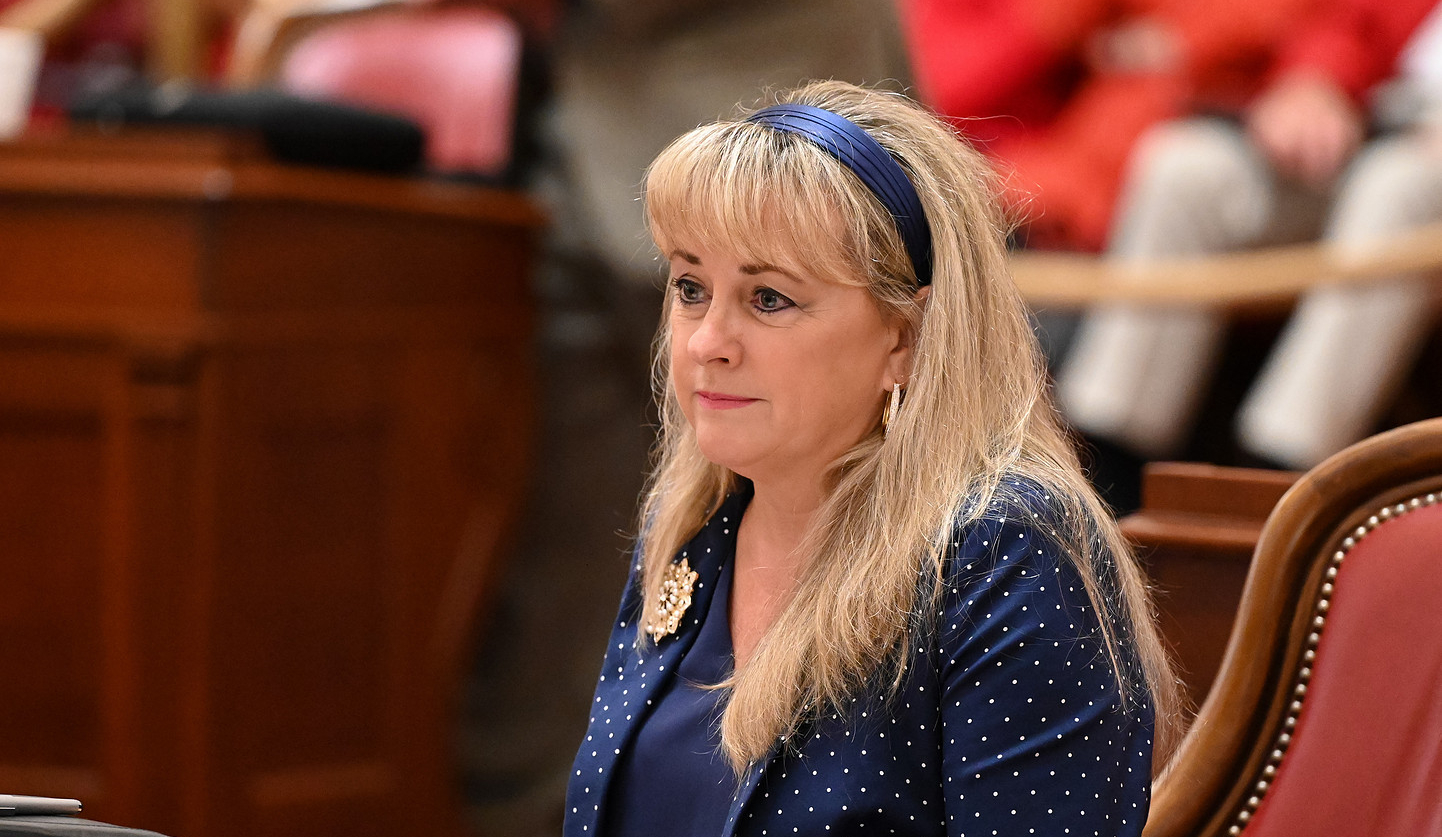
But for Naomi Miguel, a long-time congressional staffer and former presidential appointee, there’s nowhere else she’d rather be. She’s running for the State House of Representatives in the Twenty-Third Legislative District, where Republican Representative Michele Pena holds a seat that Democrats likely need to win to take control of the chamber in November.
Some advertising and public signage in the Twenty-Third District is written in O’odham, formally recognized as an endangered language. (Photo by Adam Sarvana)
With a slim 33-27 majority, Republicans are fighting to hold every House seat this year. The tight margin has brought fresh attention to the rural Twenty-Third, which—on paper—looks like a potential Democratic pick-up. It also looks like a microcosm of rural America, as residents articulate political demands at campaign events that mirror those of small-town Americans across the country.
In 2021, House Natural Resources Committee Chair Raúl M. Grijalva (D-Arizona) named Miguel, an enrolled member of the Tohono O’odham Nation, the staff director of the House Subcommittee for Indigenous Peoples of the United States. She held that position until 2023, when President Biden appointed her Executive Director of the White House Initiative for Advancing Education Equity, Excellence and Economic Opportunity for Native Americans.
As much as anything, she brings up her background to emphasize that she doesn’t forget her paperwork or struggle to understand formal instructions.
That’s when she lands the punchline: She’s been back in Arizona for two years, and she still hasn’t been able to get a driver’s license. She often can’t get mail delivered to her home address. Her life now is harder than it was in Washington, D.C., in basic ways familiar to millions of Americans across the U.S. At her campaign stops and in on-the-record conversations, you hear a common refrain: “It shouldn’t be this hard to live in rural America.”
In her Pima County kickoff speech on May 29, 2026, at the Hanam Ke:k Recreation Center in the small community of Pisinemo, Miguel described this mix of local and national challenges as a big reason she’s running for office. “Like many of you, I’ve dealt with government systems that don’t know how to deal with tribal or rural citizens,” she said. “I’ve been harassed by the Border Patrol as a teenager and denied basic services from the state government.”
Violence against Native families, especially Native women, is an enduring political issue in rural Arizona. (Photo by Adam Sarvana)
As she told the audience, this is true for too many rural Americans everywhere, whether they’re Native or not: “But the rural communities also have similar problems, where they can’t get IDs because state agencies don’t understand or have never seen their rural addresses. Some of them start with HC [short for Highway Contract, used by the U.S. Postal Service but unfamiliar to most drivers or government officials] or other acronyms,” she said. “There’s a huge overlap of issues with tribal and rural communities.”
On July 21, primary voters in each of Arizona’s 30 legislative districts will choose one person running for state Senate and two people running for state House to represent their party in the general election in November. In the general election, the top vote-getter for Senate and the top two vote-getters for House will win the election regardless of party. Miguel is one of four Democrats running in the state House primary in the Twenty-Third.
“LD23 is unlike any other of our districts in Phoenix or Tucson. It stretches from Yuma and San Luis through rural Maricopa County to the Tohono O’odham Nation, bringing together communities with very different backgrounds, priorities, and voting patterns,” Sara Kennedy, executive director of the Arizona Democratic Legislative Campaign Committee, told the Daily Yonder in a statement.
“Despite Democrats having the registration advantage, we have been unable to pick up the second House seat in consecutive cycles because of its geography, diverse communities, and split media markets. We know that success in LD23 is dependent on us building long-term infrastructure, year round organizing, and meeting voters where they’re at.”
If Miguel advances to the general election, there is good reason to think she can win. Despite currently sending one Democrat (Representative Mariana Sandoval) and one Republican to the State House, the district is rated by the Arizona Independent Redistricting Commission as so heavily Democratic that it is “outside of competitive range.” The district, which stretches from the western outskirts of Tucson more than 200 miles west to the California border, has a voting-age population that is more than half Hispanic, a group that has turned against President Trump over the past 18 months.
But with campaigning getting more expensive at every level of government, the outcome is far from certain. Like many rural areas, the Twenty-Third struggles economically. As of 2024, the median income was just $72,649 in the district compared to $81,500 statewide. Local voters do not have much disposable income to fund a political race. The state’s economic engines—the three major public universities, large employers like Banner Health, and high-profile tourism destinations like the Grand Canyon and Saguaro National Park—are located or headquartered elsewhere. In another familiar echo of rural communities nationwide, one of the biggest employers in the Casa Grande area, in the northern part of the Twenty-Third, is a private prison management company called CoreCivic.
Rather than being cheap, necessities in rural Arizona can be considerably more expensive than state and national averages. On June 1, the Phoenix average for a gallon of gas was $4.67, while in Sells, the capital of the Tohono O’odham Nation, a gallon went for $5.24 on May 29. (Photo by Adam Sarvana)
Miguel’s top two issues, she said at her kickoff, are strengthening public education—no surprise in a state where a lack of funding oversight is a major scandal—and environmental protection. That focus may resonate more strongly this year than in past races. As in rural areas across the country, data center fights have put a fresh spotlight on water usage, which is already a major issue in a region where both drought and agriculture are daily facts of life. The ongoing environmental and public health risks of Arizona’s mining legacy are an equally common concern for many residents. As recently as 2023, the Environmental Protection Agency finalized a cleanup plan at a former mine that had been officially inactive since 2009 but continued to leach uranium and other contaminants into the nearby aquifer.
Although she is not running an identity-heavy race, Miguel’s campaign is fueled in part by a shared sense of solidarity between Native American voters from different backgrounds. In addition to traditionally Hispanic agricultural communities like San Luis, Somerton, and parts of Yuma, the district includes the vast majority of the federally recognized Tohono O’odham Nation—the second-largest tribe in the state—as well as all or part of the Cocopah, Ak-Chin, Fort Yuma Quechan, and Pascua Yaqui tribes. Members of several tribes were at Miguel’s May 29 event on behalf of an organization called Arizona Native Democrats.
Roxanne Barley, a Cocopah organizer at the event, said she hopes Miguel’s campaign makes rural realities more visible to people in all kinds of communities.
“It took me an hour to get out here from Casa Grande,” said Barley, who had never been to Hanam Ke:k before. “Imagine yourself just trying to travel to a place just to get milk that you need for a recipe, you know, to put into your dinner tonight. You forgot to get eggs? Now you’ve got to travel all the way back out there just to get… some eggs.… So, for anybody out there that’s reading this article, just remember to humble yourself and realize that not everybody is on your level. Not everybody has the same access as you do. And not everybody is exposed to the same kind of environment and way of living that you have your entire life.”
The post D.C. Insider and Tribal Member Wants to Run for State Legislature on Behalf of Rural Arizona appeared first on The Daily Yonder.