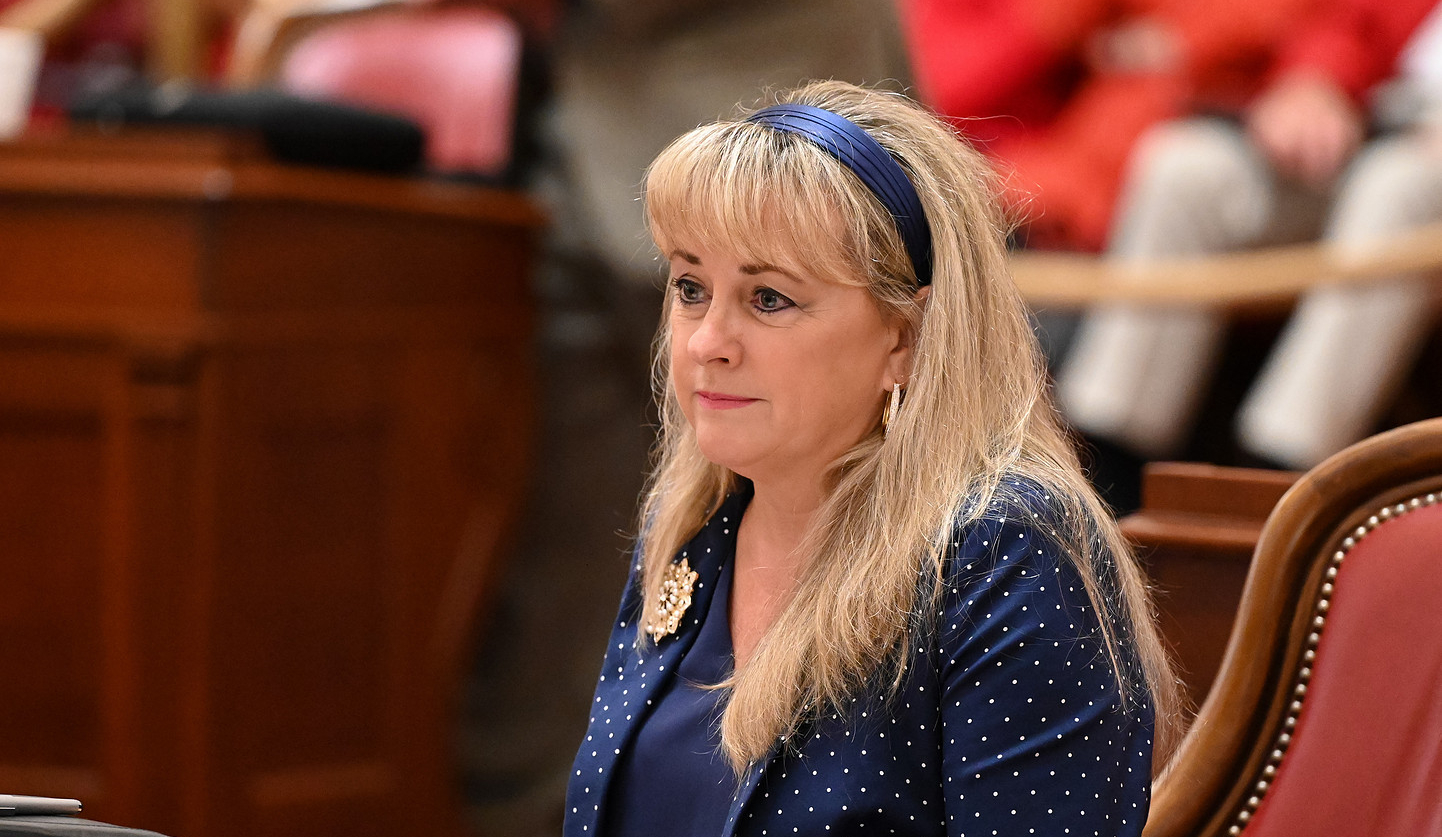


When Melinda Nelson moved to Weiser, Idaho, in 2019, she bought a house with her mother and sister that has three steps leading to the entrance. Nelson has bad knees — “bone on bone,” from advanced arthritis, she said. But initially, the steps weren’t a problem. She could hobble up them using her cane, or else her mother, who’s 79, would help her.
But Nelson’s knees got worse and worse — the result of having spent her 30s as a hotel housekeeper, where she was required to scrub the floors on her hands and knees. Last winter, Nelson’s family doctor decided a temporary intervention would be necessary. It was too early for surgery — the surgeon wanted to wait to schedule her knee replacements until Nelson, who will be 53 in July, was in her sixties. In January, Nelson’s doctor suggested they start with a ramp.
Then, at least she could skip the difficult steps at her house’s entrance.
There was only one catch: her insurance probably wouldn’t cover it. The out-of-pocket cost could total as much as $20,000 between the ramp and the installation. But Nelson was in luck: a local community organization, Love INC, had recently begun renting out durable medical equipment, including wheelchair ramps. Nelson’s doctor suggested that she look into it.
In the United States, 18 million people have travel-limiting disabilities. An estimated 6.8 million people rely on mobility devices, including wheelchairs, walkers, and canes. According to the Bureau of Transportation research, 40% of those surveyed self-report leaving the house zero times per day.
Pamela Burris unlocks the storage shed for Love INC. When the ramp program began, Love INC. needed to purchase a second storage shed for durable medical equipment. (Photo by Astra Lincoln)
This is likely at least in part related to high rates of poverty — people with disabilities are more than twice as likely to live in poverty, and only one-third of people with travel-limiting disabilities have part-time or full-time work. In addition to the demands of available transportation and limited employment opportunities that are truly accessible, many people with disabilities rely on income-dependent social services to manage their conditions. Programs like Disability Insurance have savings requirements, which disqualify participants who have more than $2,000 in savings.
For people who rely on mobility devices, ramps are often inaccessible due to their high out-of-pocket costs. While “durable medical equipment,” like power scooters and wheelchairs, is covered by insurance programs, including Medicare and Medicaid, wheelchair ramps are not. This is because Medicare classifies ramps as a home modification, and not a medical device. So someone like Nelson could use a mobility device but be unable to enter her own home while using it.
Even accessing insurance-covered products like wheelchairs can be dizzyingly difficult. A 2025 study by the Disability Rights Education & Defense Fund found that 40% of mobility device users have had a device-related insurance claim rejected in the last five years. People with disabilities are routinely recommended to find alternate methods of financing necessary equipment. Their doctors and social workers tell them to turn to neighbors, to relatives, or to GoFundMe.
But in Weiser, Love INC is a community solution.
Love INC — or Love In the Name of Christ — is a national church assembly program that organizes regional church networks to conduct outreach in their communities.
When Pamela Burris, the Washington County chapter’s Executive Director, joined Love INC in 2009, the Weiser office mostly functioned as a food pantry. Since then, they’ve significantly expanded their programming to meet the needs of their participating churches’ members.
They organize a backpack drive for school children that’s tailored to local teachers’ back-to-school lists. They give out furniture to households that can’t afford couches or beds. And, for several years, they’ve built out a durable medical equipment library to fill the gap for the 15% of Weiser’s uninsured residents.
The organization is now well-known in the community for these “gap ministries.” Neighbors call in with an unsolvable problem, and Love INC finds a way to save the day.
“We kept getting requests for ramps, and we kept having to say ‘yeah, there’s nobody that does that. We can’t help you,” Burris said. But in Weiser, where 25% of residents are seniors, and 15% have no health insurance, the need was obvious.
Pamela Burris, director of Washington County’s LOVE INC chapter, at their office in Weiser, Idaho. (Photo by Astra Lincoln)
One resident Burris had spoken with, an amputee, had to undergo surgery on her remaining leg. She’d be in a wheelchair for months and stuck at home throughout the duration of her recovery.
Another, an elderly man, had a sudden medical event that made him a permanent wheelchair user overnight. His Medicare coverage included medical transport; at the time of his appointments, transport workers would carry him in and out of his house. But the rest of the time, he was locked at home, with no way to make it down the eight steps that led to the rest of the world.
Finally, Burris did some research — maybe there was a way for the organization to help people navigate the insurance application process, she wondered. When she learned that there are virtually no insurance providers that cover ramps (only VA medical benefits will, and only in some circumstances, like when a person develops a mobility-limiting condition while on active duty), Burris knew she’d have to find a way to provide the ramps herself. The only problem? She’d need tens of thousands of dollars, a storage facility, and a team of people who knew how to install the finicky portable ramps according to precise Americans with Disabilities Act (ADA) specifications.
Burris was able to get local grant funding to purchase a couple portable ramps — and then scored a couple of second-hand ramps on Facebook Marketplace that were listed at 90% less than the MSRP. Within a year, Love INC had secured four ramps; as of summer 2026, three are in circulation.
Local volunteers install a ramp in Weiser, Idaho. (Photo courtesy of Pamela Burris)
The installation turned out to be the hardest part. The ADA requires that, for every inch of vertical rise, there has to be a foot of run. A porch with five steps, each step at one foot tall, requires a 60-foot-long ramp, even if the front door is only three feet from the street. “You have to turn corners and make interesting shapes and wrap around,” Burris said. “We get out graph paper, and we plot it out. It’s intimidating. And it never goes as planned.”
Nelson applied for a ramp in January 2026 — filling out the several-dozen page application, which included a doctor’s note, a complete income history, and a landlord consent form she would have had to get notarized if she rented her home. A few days later, the ramp was ready.
By then, Love INC had installed a handful of ramps already, in elaborate shapes through narrow front yards and busy driveways around Weiser. But Nelson’s ramp would be easy, Burris was sure: “just a straight shot. There’s no platforms, there’s no corners that were turned or anything.” She texted her team to ask if anyone was up for a super-easy install. “Never say that,” Burris said. “Because we were there all afternoon, and it did not go smoothly.”
But eventually, the team figured out the snags with the half-inch sockets. They bolted everything in, and left. Now the ramp belongs to Nelson, for however long she needs it. And, if an eventual knee replacement renders the ramp unnecessary, the Love INC team will be back to uninstall and store it until it’s needed by somebody else.
Nelson’s had her ramp for six months now. And in that time, it’s done exactly what the best accessibility measures accomplish: faded unnoticeably into the rest of her life, an unremarkable part of the background.
“There’s not much to say about it,” Nelson said. “Now everything’s just good.”
The post Insurance Doesn’t Cover Wheelchair Ramps. In Idaho, a Church Group Finds a Solution. appeared first on The Daily Yonder.