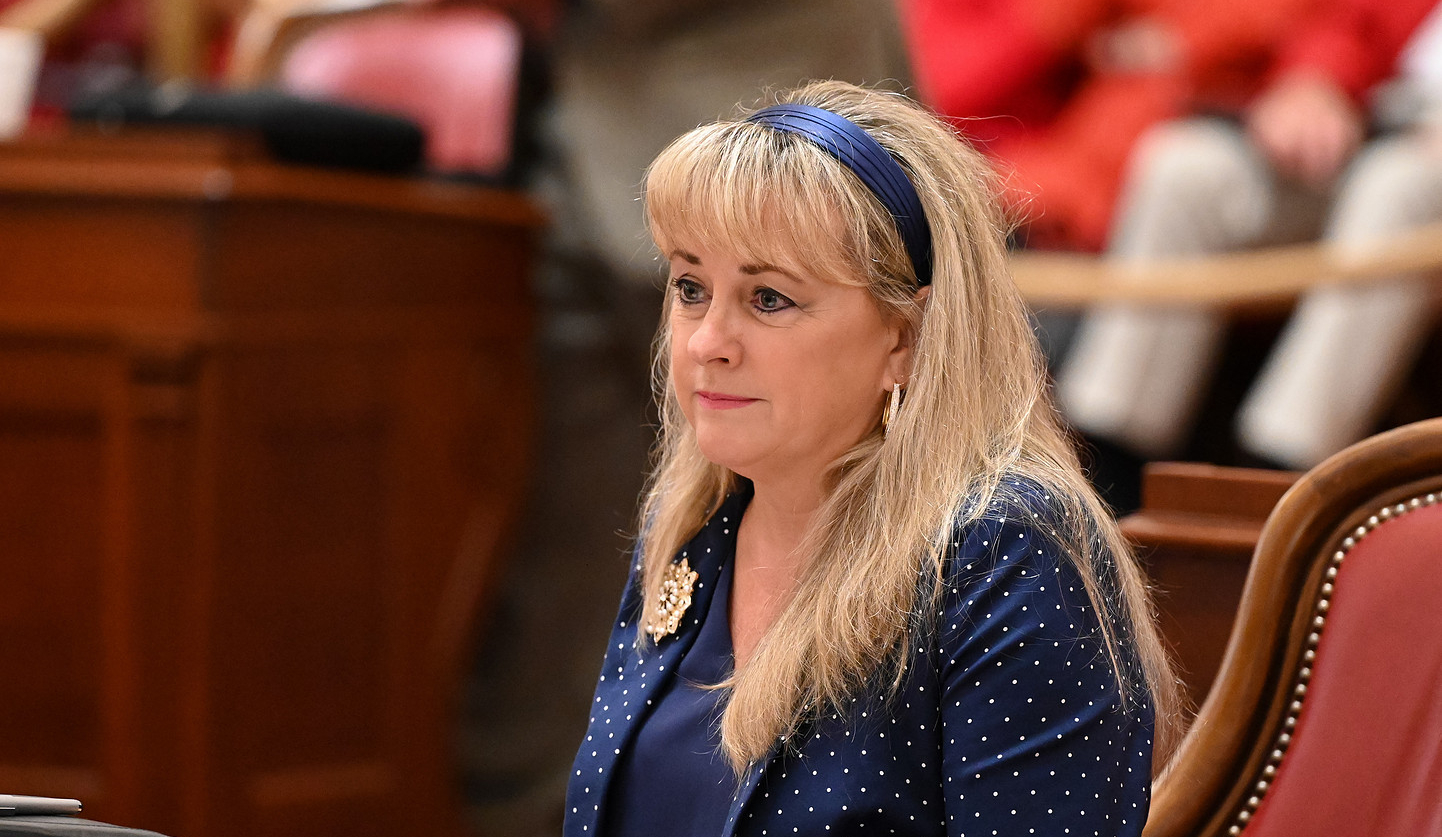


During a rainy summer afternoon at Zadie’s Market, a restaurant housed in what used to be the jail in Marshall, North Carolina, a group of 11 people sat on the patio in front of a dinner crowd, taking turns singing ballads.
Ballads are songs that tell stories, typically sung without musical accompaniment. The earliest songs were rarely written down, so they varied between singers or families. Many of these ballads were brought to Appalachia by settlers from the British Isles. They often recount tales of heroes, betrayal, doomed romance, and even murder. Some can even be a bit raunchy, as ballad singer Donna Ray Norton explained to the crowd.
“Bawdy ballads are like the dirty ballads,” said Norton, standing at the mic. Norton is an eighth generation ballad singer from Sodom Laurel, North Carolina, a small community in Madison County. “Are there any kids here right now? I know that there was one that just left.”
After making sure the coast was clear, Norton launched into a bawdy ballad called “The Darby’s Ram.” The song cheekily tells the story of an absurdly large ram, with lyrics like:
This Ram had such a long tool, it drug upon the ground
It dug a ditch six feet wide, from London to Darby’s town
The audience responded to the lyrics with laughter, joining Norton on the lines that repeated after every verse. The song goes on, line after line, describing the sheer enormity of the ram:
The legs on this ram were spread so far apart
Every soul in Darby dreaded to hear him fart
Traditionally, ballads were sung in private, among family. Over time, singers began performing them in public. At the ballad swap, singers took turns stepping up to the mic, from oldest to youngest. Their voices made a haunting, plaintive sound, cutting through the noises of the lively audience.
Norton co-founded the Marshall ballad swap in 2023 with her aunt, renowned ballad singer Sheila Kay Adams. Adams has earned national recognition for her musical tradition, including a 2013 National Heritage Fellowship from the National Endowment for the Arts. “I’ve always idolized her, and she just sounds like home to me,” Norton said.
Eighth-generation ballad singer Donna Ray Norton MC’d the ballad swap at Zadie’s Market. (Photo by Sarah Melotte / Daily Yonder)
Since 2023, the ballad swap has become an important opportunity for these singers to share their tradition with others. But when Hurricane Helene hit North Carolina in 2024, bringing what some described as a “1,000-year flood,” the future of the event became uncertain. The Old Marshall Jail, the home of Zadie’s Market, was full of mud and water. Norton was concerned about how the building’s destruction might hurt the ballad swap.
“The ballad swap’s sort of like my baby, you know?” Norton said. “What if we don’t have the same momentum that we had going before?”
We know all too well how natural disasters physically impact communities by destroying property, devastating the landscape, and claiming lives. But what might be less obvious is how a community’s cultural practices are affected. Experts say climate change likely made Hurricane Helene more dangerous, reflecting a broader pattern in which warmer global temperatures are fueling more intense storms and extreme flooding.
In the aftermath of Helene, amidst all the uncertainty, Norton found comfort in singing ballads.
“I really leaned into the ballads during that time as a way to connect with myself and my people,” Norton said.
But not every ballad was a comfort. Many of these traditional songs touch on themes of land and loss. Darci DeWulf is a ballad singer who lives in Marshall. She said that right after the flood, emotions were still too raw to tackle songs with those themes.
“We did avoid for a long time any songs about rivers or waters rising,” DeWulf said. “I mean, it was like, you think, ‘Oh, I’ll sing this.’ And you get to about the second verse, and it’s like, ‘The river’s gonna flood.’ No, I can’t, you know, too soon. Too soon. I can’t do this.”
The patio of Zadie’s Market sits right on the banks of the French Broad River, which flooded Marshall during Hurricane Helene in September of 2024. (Photo by Sarah Melotte / The Daily Yonder)
But with time came the desire to return to some of those ballads.
Helene wasn’t the first historic storm that afflicted western North Carolina. In 1916, another flood swept through the Blue Ridge Mountains, changing the course of rivers and killing around 80 people. A ballad was written about this storm, called “The Flood of 1916.”
A few months after Helene, ballad singer Sarah Elizabeth Burkey of Jackson County, North Carolina, decided to learn this song, but she had a hard time with it at first.
“My brain resisted absorbing it and memorizing that song, because the story is such a hard one,” Burkey said. Eventually, she did learn the song:
In the month of July, in the year sixteen
The most terrible storm you ever did see
Made its way from the ocean wide
And struck with force
On the mountainside
The ballad singers leaned into their tradition in other ways, too. While the Old Marshall Jail was being restored, the group took their show on the road. For them, it was a chance to be together doing something they loved, while also raising awareness about the storm’s impact on their home. Norton said the group performed sold-out shows in places like Charleston, South Carolina; Asheville, North Carolina; and Floyd, Virginia.
“Just all these different things have blown my mind. It’s just been crazy,” Norton said.
Attendance boomed when the ballad swap returned to Marshall after its time on the road. Locals showed up in droves to support ballad night, along with tourists and people who came to see how the town had fared since the storm. But in a region where scientists say climate change is making extreme floods more likely, Helene may not be a once-in-a-generation event. For the ballad singers, the effort to sustain their tradition is now unfolding against a future where floods like Helene could happen again.
“I think it was just sort of an eye opener for a lot of people,” Norton said. “Just about how special things are and how fragile everything is.”
For these singers, the storm has deepened their commitment to sustaining ballad singing for future generations.
“It’s not just about the songs,” Norton said. “It’s about the stories and how they were passed down, or why. I hope that people are just still curious about them and want to keep learning them and continue to pass them down, and that younger generations continue to be interested in them somehow.”
This article is part of the Living Traditions project, featuring an assortment of stories and podcasts about folklife in central Appalachia.
Read More Living Traditions
Sign up for email alerts.
Sign up
The post In Marshall, North Carolina, a Group of Ballad Singers Reflects on how Hurricane Helene Affected Their Tradition appeared first on The Daily Yonder.